Friday, June 3, 2011

Ol’ Crazy Beard


 “Duuuuuude!  It’s time to go tubin’!”  Make sure everything is waterproof, find the sunglasses that you don’t mind possibly losing as you go through the Tube Chute, find out what size cooler is allowed on the river this year, and then rent inner tubes for yourself, all your buddies, and of course one for the cooler (unless you’re cool enough to own your own tubes).  The city of New Braunfels is synonymous for any fun-loving Texan with summertime tubing on the river or, if you don’t mind standing in line, Schlitterbahn Waterpark Resort.  There’s lots of water, lots of sun, lots of people watching, and it’s the highlight of a lot of summers. 

But not for Ferdinand.  For Ferdinand Jacob, or F. J. to those in the know, New Braunfels was a place where he could finally stop and put down some roots and get to down to the serious botanizing that he loved.  Ferdinand was educated at the University of Wiesbaden, the University of Jena, and the University of Bonn.  He moved to Frankfurt and took a teaching position at the Bunsen Institute.  Things were going all right for young Ferdinand.  But then he looked around himself and didn’t like what he saw.  It was Germany in 1827, and Ferdinand thought that things ought to change.  Unfortunately for him, most of his colleagues and family, and more importantly to his safety, the government, thought differently.  By 1834, Ferdinand was active in agitating for reform of the German government, and found himself so much at odds with everyone around him that he split the scene and left for the United States.  He first went to Belleville, Illinois to live with a group of other German expatriates.  From Illinois he traveled by boat to New Orleans.  From New Orleans, he started for Texas, but in an effort to escape some violent Indian activity, got diverted to Jalapa, Veracruz, Mexico, where he collected plants and insects for just over a year.  Once again, Ferdinand headed for Texas, but wound up shipwrecked near Mobile, Alabama.  By the time he finally got to San Jacinto, Texas, it was the day after the final battle in the Texas Revolution.  After all that traveling, Ferdinand Lindheimer finally established a residence in a German colony known as New Braunfels, Texas.  Once established, the “Father of Texas Botany” collected fifteen hundred species of plants in South Texas over the next thirteen years. 

No reports are made on whether or not he went tubing in the river, but I like to think of him in a full-body swimsuit with water drops caught in his crazy beard as he whooped it up in the river with bottles of homemade beer he kept cool in the Comal. 


Here we have the infamous 1843 tube trip down the river undertaken by those mad-men of botany Ferdinand Lindheimer, George Engelmann, Asa Gray, and Thomas Drummond.  Everything was fine until they found a rope swing.  The lesson here is that there’s a fine line between fun and all-out crazy. 


There are 48 species and subspecies and one genus that carry Lindheimer’s name.  Most of these are plants that you see every day (or in some cases, every time it rains).  Lindheimer named many of these species after acquaintances, or after the their native location.  Then there are those named for Ferdinand Lindheimer, or to honor his accomplishments.

One of the biggest and baddest grasses for our area is the ‘Big Muhly’, or Lindheimer Muhly.  Muhlenbergia lindheimeri makes a huge, hulking clump that gets up to seven feet tall and six to seven feet wide, with large greyish-white plumes for flowers set against the blue-grey foliage.  The flower-heads start out mahogany-purple, and turn a soft grey. It’s a tough, drought tolerant grass that makes a good replacement for Pampas Grass.  ‘Big Muhly’ will grow where others fear to tread, making itself at home in hot, dry, rocky locations. 


‘Whirling Butterflies’ is likely not the name that Ferdinand Lindheimer assigned to Gaura lindheimeri, though it’s an accepted moniker now.  Gaura is an airy plant with red-tinged leaves and pink/white flowers.  Gaura can easily take the full, hot sun, but will also grow and bloom steadily away in part shade.  It gets up to two to three feet tall and wide, and blooms throughout the spring, summer and fall.  It’s a hardy perennial that’s comfortable in a dry, rocky spot, and will just keep adding more and more blooms until it freezes to the ground. 


The Antique Rose Emporium, source of so many wonderful things, introduced a rose as part of their ‘Pioneer Rose’ series called ‘F. J. Lindheimer’.  This is a hardy shrub with full, yellow-orange blooms all year.  Reports are that this rose even made it through hurricane Gustav in Louisiana, springing right back up after getting flattened in the storm. 


Lindheimer, in his years of botanizing in Texas, recorded enough species of plants to literally fill a book.  There are hundreds that we see around us all the time, familiar plants that got a little nudge and a name by our bud F. J.  One that you can see just by walking down the block in many cases, or scouting around in any half-shaded woodsy area is ‘Turk’s Cap’.  Malvaviscus drummondii is a chunky, large-leaved shrub that blends in to any woodsy spot until the dark red flowers appear, and then it’s impossible to ignore.  ‘Turk’s Cap’ has a different kind of bloom, with the petals staying furled around the stamen and looking more like a weird little balloon than a flower.  ‘Turk’s Cap’ gets up to four feet tall and five feet wide, and comes back dependably every spring. 


Lindheimer probably didn’t have to go too far to find a Bald Cypress.  These giant trees line rivers in Texas, reaching their massive roots down into the water to drink mightily from the cool waters of rivers like the Comal, the Guadalupe, and the Frio.  Taxodium distichum can easily reach seventy to eighty feet tall.  The feather-like leaves emerge bright green in the spring and persist through the summer.  In the fall, they will turn bronze before they fall off. 


One of the more easily recognizable characteristics of the Bald Cypress is the knees it produces with sufficient water.  Though it doesn’t need a lot of water to survive, if it has it, the Bald Cypress will grow at an astounding rate, and often produce “knees”, or little humps of roots like perfectly camouflaged garden gnomes around the base.  They’re really neat until you have to mow around them.  


Lindheimer named quite a few plants after his fellow botanists; people like Thomas Drummond.  One of those plants is a little lily that I look forward to every time it rains.  Cooperia drummondii, the ‘Rain Lily’ only makes its appearance after a good soaking rain, so it’s not too common around here, especially lately.  But as soon as the ground gets soaked, they pop up overnight, all over the place.  There are places along my drive home that will be completely covered in one and a half inch, pure white blooms after summer showers.  White seems to be the most common color, but I was very glad to see orange ones come up in my yard as well.  So much so that whenever I see one while mowing, I’ll make a wide swath around it to let it go to seed.  The little blooms are held up on naked stalks reaching six to ten inches tall, and they last for a day or so.  The leaves will elongate after the bloom has faded away.  Then you just have to wait for the next storm. 


Ferdinand tromped all over three different states in the Unites States, and one in Mexico looking at plants and recording them so we’ll know just what to call them when we spot them along back roads throughout Texas.  But another creature got the “Lindheimer Treatment”: the Texas Rat Snake, or Lindheimer’s Rat Snake.  Elaphe obsoleta lindheimeri is a non-venomous snake that will hang out in barns and sheds and try to keep them rodent free for you, if you’ll leave them alone to do it.  Lindheimer collected the first specimen of the Texas Rat Snake in New Braunfels.  My experience with Rat Snakes is that they’re pretty skittish, and will zip away as fast as possible, usually disappearing into some hole you would have never seen otherwise.  My other experience with the Rat Snake is that whenever I see one (because they always seem to surprise me), my brain short circuits for just a second and toggles back and forth between “good snake?” and “bad snake?” or “shoo it away?” and “run like crazy?”.  I’ve read accounts from people who say the Texas Rat Snake is aggressive, but they sure never have been with me.  Maybe that’s because I’m usually trying to get myself into reverse as fast as possible. 


Apparently, they’re pretty acrobatic, too.


There are actually a couple of great, or at least really interesting, books about Ferdinand Lindheimer.  One is Life Among the Texas Flora: Ferdinand Lindheimer's Letters to George Engelmann, a collection of letters written by Crazy Beard himself.  George Engelmann, who was so cool he got a daisy named after him, along with Asa Gray, wrote another.  It has one of those titles that really reaches right out and grabs you: Plantae Lindheimerianae: An Enumeration of F. Lindheimer’s Collection of Texas Plants, With Remarks and Descriptions of New Species, etc.  Oh yeah, they did it; they used “etc.”.  That’s what keeps you turning the pages. 


Monday, May 9, 2011

Butterflies and Angels, and Everything Nice

“Well, Grandma always called it a Jumping Jehoshaphat Willy Wally Wamalooma.”  But then, Granny always was pretty imaginative. 
I’ve talked to a whole lot of people about a whole lot of plants, and the resistance to using botanical names of plants never ceases to amaze me- and amuse me.  My favorites were always the ‘Butterfly’ plants.  There are a dozen different variants on the butterfly theme, from weeds to bushes to vines to ‘Swirling Butterflies’.  Selling plants is, in part, a job of translation. 


Asclepias curassavica
 
What’s usually called ‘Butterfly Weed’ is an Asclepias.  Asclepias curassavica is a three to four foot perennial with orangey-red sepals and yellow petals.  The ‘Butterfly’ part of the name comes from the Monarch butterflies that will swarm the plant as they migrate through.  Apparently, Asclepias nectar is pretty sweet and highly addictive. 


Monarch Butterfly on Asclepias, or 'Butterfly Weed', or 'Milkweed', or...

Asclepias also gets called ‘Milkweed’ because of the milky, sticky sap that for many people is an irritant to their skin.  In fact, it’s theorized that the nectar eaten by the Monarch butterflies makes their bodies very bitter, and once a bird tries to eat one, they won’t want another.  That, in turn, inspires copycat butterflies like the Viceroy, which take advantage of the hard work of the Monarch.  They’re the opportunists of the butterfly world. 


Monarch Butterfly


Viceroy Butterfly- riding the coat tails of the Monarch
And then there's the Butterfly Bush.  The ‘Butterfly Bush’ I’m familiar with is Buddleia davidii.  It comes in pink, purple, magenta, white, lilac, and probably a dozen more I’ve just never seen.  This plant also makes a flower that drives butterflies a little bit crazy.  Maybe they have sweet tasting flowers, or maybe butterflies just aren’t that picky.


'Nanho Purple' Butterfly Bush driving a butterfly crazy

‘Butterfly Bush’ has eight to fourteen inch bloom clusters of tiny little flowers that can get so big that they make the branch droop.  The bush easily gets five to seven feet tall, and if you deadhead, it will bloom all summer and bring you a lot of butterflies to watch.  ‘Butterfly Bush’ is one of those bloomers that can grab you and drag you across the yard with its fragrance.  Up close, the scent is nearly a sensory overload.  Nerd note: apparently the name most often used is Buddleia, but the actual, correct name is Buddleja.  But to me that "j" just seems wrong.
A plant that doesn’t necessarily have a wonderful scent nor attract butterflies is a rose sometimes called ‘Butterfly Rose’.  This rose is usually sold now as ‘Mutabilis’, but at one time was sold as ‘Tipo Ideale’. 

The name in this case has nothing to do with attracting butterflies.  Instead the blooms, as they change (or mutate) from orange to yellow to pink, look to some people like a bunch of butterflies that have landed on the shrub. Mutabilis is an absolutely awesome rose that blooms heavily in spring and fall and sporadically throughout the summer.  In addition to the butterfly-like flowers, it just makes a great landscape shrub. 
It’s one thing to think of butterflies when you see an especially beautiful flower.  But what about when a flower is just so big, and blooms so enthusiastically that no terrestrial comparison will do?  In that case, you gotta get celestial.  Call it something grandiose, something that verges on the religious.  Something like ‘Angel’s Trumpet’.  The problem is that ‘Angel’s Trumpet’ is such a great name that it’s hard to contain it to just one plant.  There are at least two that commonly get assigned that Heavenly handle.  To be fair, they are similar, and the differences have more to do with their habit than the flowers themselves. 

Datura wrightii

Datura wrightii is being seen more and more as one landscaper after another is seduced by its big, billowy bloom.  And honestly, it’s hard not to be seduced.  Datura flowers open at night, so when the sun comes up they already look like they’ve been hard at work, and they wither by mid-morning.  Datura also sports golf-ball sized, spiny seedpods that are nearly as interesting as the flowers or its nocturnal nature. 
Datura seedpod
So to tally up the attributes of Datura so far, you’ve got a “trumpet” of a flower, you’ve got a plant that gets up to some sort of hijinks at night, and you’ve got a little sea urchin seedpod.  Aside from all of that, Datura is a far-out plant.  There are whole religions built around Datura.  Is that because it’s reminiscent of angelic instruments.  Is it because of the wild flowers?  Maybe partly, but also because it can get you high.  Or kill you. Datura is poisonous, and both shamans and severely misguided teenagers have used it to see visions, or smell colors, or something.  I’ve been told, however, that Datura is poisonous enough that a person’s body will initially reject it.  Apparently, you have to really work at it to ingest Datura.  I didn’t ask my source of this information how he happened to know this.  I just said “Cool, man,” and quickly finished my beer. 
Another ‘Angel’s Trumpet’ is Brugmansia.  Brugmansias, or Brugs as they’re called in gardening forums, also have large trumpet-shaped flowers.  Whereas Datura gets four to five feet tall and wide, Brugmansias just don’t seem to stop growing until they freeze to the ground.  They can easily get seven to nine feet tall.  The flowers on Brugmansia hang down, unlike Datura blooms, so when the bush gets that tall, it’s possible to walk under them and look up into their throats.  And you can see the blooms all day because they won’t close or wither in the morning.  Brugmansia flowers come in yellow, peach, white, salmon, dark peach, dark yellow, and really, really bright white.  There are also a whole slew of double flowering versions.  What there aren’t are any blue or bright red flowering Brugmansias. 


Brugmansia: The other 'Angel's Trumpet'
 There are differing opinions as to whether Brugmansia is poisonous or not, but does it matter?  When it comes to ‘Angel’s Trumpet’: one’s definitely poisonous, the other is probably best left alone anyway.  Again I refer to my cardinal rule: don’t eat your landscape
So the whole troop of ‘butterfly’ plants, the ‘Angel’s Trumpets’, and the ‘Glittery, Sparkly Fairy Wings and Happy Dreams’ plants got their names because they attract butterflies (or angels) or because they look like butterflies or bugles.  And then there are the plants that people name as a way of wistful thinking.  Or clever advertising.  Hence, Lucky Bamboo.
"Lucky (not)Bamboo" 
I’m not going to dispute the lucky part.  Someone once gave me one of these plants and I just don’t have it in me to throw a plant away.  But it never gave me any good luck, as far as I could tell.  But I will dispute the Bamboo part.  It’s not.  It’s Dracaena. 
"Corn Plant"
You know those seven foot tall ‘Corn Plants’ you see in the corners of doctors’ offices?  That’s Dracaena.  It makes a great houseplant, but I’m unclear as to how it gets infused with good luck. 
What’s in a name?  The difference between good luck and not, I guess.  It’s tempting to try to correct anybody who tells you what their granny used to call such and such plant, and maybe it’s even the responsible thing to do.  I don't know.  But when somebody asks you “Is that what Pappy always called a Wizamaroo Tree?”, one option is to just nod and say, “Yep, that’s the one.”  And sell them a Lucky Bamboo.


Thursday, April 21, 2011

Kind of Blue

It’s spring time, and looking out across the nursery I can see frothy waves of fresh green, spiced with yellow, orange and red flowers.  Apparently Robin Williams once said “Spring is nature’s way of saying “Let’s Party!”.”  As the new leaves popping out from their dark parent branches gently assault my eyeballs, I totally get what Robin Williams was saying.  Walking through the greenhouses here, it’s easy to get sort of blasé about all the flowers: sure, that’s a nice yellow; okay, that’s a pretty vibrant red, mmm hmm.  And then there’s something like Bicolor Sage.  It has a pow all its own, but in a good way.  And it’s something of a relief after all the fireworks of the reds and yellows, and even pure whites.  Here are some of the best blues for your garden to soothe your senses, maybe while listening to some John Lee Hooker. 
 Oops!  Wait, wait, wait.  I told myself I wasn’t going to do that.  I wasn’t going to do some kind of cheesy “blue flowers/blues music” type of thing.  So here they are, with no distractions: the straight-forward blues.

Bicolor Sage

Bicolor Sage is a low-growing sage with electric blue flowers set against dark bronze foliage.  Either full sun or part shade will keep this salvia blooming throughout the warm season.
The blue blooms of Bicolor Sage are vivid and cool even when no longer on the plant. 
Bicolor Sage blooms on a Datura leaf


Plumbago is a low, mounding shrub with light, clear blue flowers.   
Plumbago auriculata
 Here in Austin it usually stays between one foot and three feet tall.  I’ve heard stories about Plumbago becoming large, six-foot shrubs in San Antonio.
Salvia transylvanica
This salvia gets up to 30 inches tall and 18 inches wide.  It produces light blue flowers as soon as it warms up in the spring, and it will re-bloom if cut back after the first flush.
          
Mealy Blue Sage
Salvia farinacea is one of those workhorses of the garden.  It just keeps going and going.  It needs at least part sun to bloom, but once it does start to bloom, it’s spectacular.  ‘Mealy Blue Sage’ is fairly drought-tolerant. 

Blue Eyed Grass

Syrinchium angustifolium is a short plant that shines up at you in the spring.  It only gets about 10 inches tall, so it would work well in the front of a bed, or even as a border. 
Starry Eyes
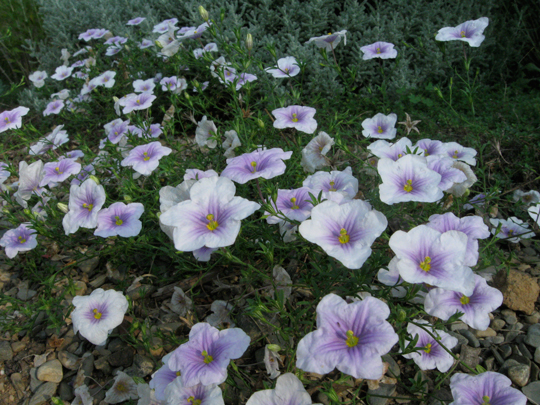
Nierembergia gracilis is another low growing perennial that blooms all summer.  It’s drought tolerant to the point of being easily over-watered. 

Shrubby Purple Skullcap

           
Scutellaria wrightii only gets 10 to 12 inches tall by 18 inches wide.  It pretty well covers itself in purple-blue blooms all spring and summer, which stand out against the light grey foliage.  Very drought tolerant, this plant is a good candidate for a xeriscape bed.  Or even a zeroscape bed. 
            

Gregg's Mistflower
This is cocaine for butterflies.  Eupatorium greggii grows quickly up to 24 inches and blooms its crazy head off all summer.  It sports medium sized, pincushion flowers that you may not even see in the spring because they’ll be covered in butterflies. 


Po' Lightnin'
Here, with absolutely no reference to ‘the blues’ or ‘feeling blue’, nor any relevance to this blog entry at all, is a picture of a statue of Sam ‘Po Lightnin’ Hopkins, who just happens to have been one of the best blues musicians in Texas. 


Ha.

Friday, April 1, 2011

Nerd!


Keanu Reeves looks like an Asian man, and then he looks like a teenage girl, and then he looks like an older, balding guy in coveralls.  Wearing some kind of outfit that constantly changes the way he appears, he stands in front of a group of civic-minded businessmen and tells them about the dangers of  “substance D”. 
Last night I started to watch A Scanner Darkly, which features a cartoon version of Keanu as a cop in a drug addicted, futuristic society in which nearly everyone is addicted to “substance D”. 
The drug, Keanu claims, comes from a plant he identifies as Clerodendron ugandens, which sounds remarkably like a plant called Clerodendron ugandense, which I have planted by my kitchen door.  I guess I just didn’t realize it was such a dangerous plant.  Then Keanu shows his audience a picture of “Clerodendron ugandens”, and the picture he shows is actually of Plumbago auriculata.  Plumbago is also a pretty flower, but it’s no Clerodendron.  I spent the next 20 minutes thinking about Clerodendron and wondering what else he was going to mis-identify throughout the movie.  And this is the problem with being a plant-nerd.

The dangerous and apparently addictive Clerodendron ugandense

Plumbago auriculata

I am a plant-nerd.  I have been for years.  Moreover, I love being a plant-nerd.  I like being around other plant-nerds.  I like the language (all those obscure Latin names and lanceolate thises and alternate or opposite thatses).  I love how plant-nerds remember places and times by what was either leafing out or blooming.  But there’s a drawback to this hyper-awareness of plants.  The process of plant identification can get in the way of, for example, watching a movie.  And, be warned, it can get annoying to non-plant-nerds.

About fifteen years ago I lived with three other guys while we all went to school.  At some point, a copy of a Sports Illustrated swimsuit edition showed up, which I guess is not that unusual in a house full of college-age guys.  I remember one of my roommates flipping through it one day and making some comment like “Gee, look at this young woman.  She looks like she comes from a nice family, and she’s probably a great cook as well.”  Granted, my memory of the comment may be a bit fuzzy.  In any case, he turned the magazine my way, and there was this woman in a bikini with a hibiscus behind her.  Fifteen years later, I have no idea is she was a brunette or a blonde.  I don’t remember what the bikini looked like.  I do remember wondering if that was a ‘Lord Baltimore’ hibiscus behind her.  Plant nerdness strikes again.
This is an advertisement for a Crinum called 'Elizabeth Traub'.  Trust me, there's a flower in the picture.


My wife and I decided to watch the original ‘Star Trek’ series.  For over a year we watched Captain Kirk smirk his way across the universe with Spock and Bones.  Whenever they found themselves on Albyron-6 or some such thing, and if it was supposed to be a tropical planet, I was always amazed at the foliage they had to hack through.  Apparently there are a lot of Philodendrons and Pampas Grass in space.  And if it's a really alien planet, the Philodendrons are painted silver.  Consequently, I missed some of the plot lines, though that doesn’t really matter with Star Trek.  Here’s the plot to three-fourths of the Star Trek episodes: the Captain and crew encounter some kind of weird, alien life-form- Spock says “logically”-  Captain Kirk seduces any female alien that looks even remotely human- the entire ship allllllmost either blows up or dissipates into pure energy- Captain Kirk gets a far-off look in his eye and comments that by learning about the aliens, they actually learned about themselves.  Throw in a few Ficus trees, and you’ve got a show. 

The Captain contemplates a dangerous Philodendron.

Pretty much wherever my wife and I go on vacation, we wind up in a plant nursery somewhere, looking past that seasonal annuals or the tomatoes for that plant that we just can’t find around Austin.  This has led to us once carrying a nearly thirty-gallon tree back to Elgin from Medina.  Or holding our luggage in our laps because the back seat was full of perennials.  Or nearly causing a wreck because we’re trying to identify a rose on a fence as we zip past at 70 miles per hour.  Or keeping plastic baggies in our pockets whenever we go on a walk because you just never know when a few errant seeds might happen to fall off a really interesting plant. 

So this is the dark side of plant nerdiness.  Go ahead, put some marigolds in your front bed, or some petunias in a pot.  Those are just gateway plants.  Soon enough you’ll be planning your weekends around whatever is coming into bloom.  Now you’re a plant-nerd. 

Enjoy!

Friday, March 18, 2011

Go, go, go!

No time for a blog this week!
We have trees going to Dallas, Frog Fruit going to San Antonio, Blackfoot Daisies going to Rockport.....
Here comes the San Antonio run.

Walking down the driveway gets bit dicey this time of the year.  You're apt to get splatted on the front of a delivery truck.
...and there it goes. 

Spring Break '11!!

Friday, March 4, 2011

Groundcovers


I’ll start out by saying something that I know will elicit boos and hisses from some sectors: I like St. Augustine grass.  And like the governor of New Jersey, I said it… and I did not vaporize.  I think turf grass has its place, just a very specific, very defined place.  BUT, for those places where turf just isn’t going to work, whether because you want to reduce water usage, or just want something more interesting than a solid green mat, groundcovers are the way to go.  There’s a whole world of ‘em.  And now I’ll say something to make greenskeepers cringe: as much as I like St. Augustine in some places, I generally like groundcovers better. 
Sod has its place
The stuff we all know- Asian Jasmine, Dwarf Mondo Grass, Boston Ivy- are all valuable plants, but just about everything that can be said about those plants has been said, so I’m not going to try to add to it.  Instead, I’ll give you a few ideas of groundcovers that you’re not likely to see, for example, around a college dormitory or a shopping mall parking lot.  Not that there’s anything wrong with that… 
Like anything else in the plant world, groundcovers run the gamut of colors, textures, and sheer, unabated voracity.  There are dainty, ground-hugging species that might surprise you with their tenacity, and there are big, bulky, don’t-stand-still-or-it’ll-swallow-you plants that can be managed with a weed eater. 

Wedelia trilobata

Wedelia is one that walks a fine line.  Wedelia will behave itself to a certain extent, but before you know it, it’s crept over the sidewalk and is dodging in and out of traffic.  With little, bright yellow flowers set off by the dark green, rough textured foliage throughout the warm season, Wedelia is pretty enough that you’ll keep it once you have it.  But as you’re hacking it back in mid-July, you’ll wonder if it was a good idea after all.  It was, it was.  Wedelia is equally happy in full, hot sun or part shade.  It needs plenty of room, but doesn’t need a whole lot of water or attention.  Wedelia will only get six to eight inches tall, but seems endless in its reach.  The tendrils will root wherever they touch the ground, and continue growing from there.  Let it freeze in the winter, cut back the dead vines in the early spring, and get out of the way. 
Sweet Potato Vine 'Marguerite'
Sweet Potato Vine is NOT an ingredient for a Thanksgiving pie.  The name comes from the yam-like tuber that the plant makes underground, given time.  There are three main varieties that you see used in landscapes.  There’s the chartreuse-colored one that’s called ‘Marguerite’ or ‘Margarita’ or ‘Margarite’, and there are two that are so dark purple that they’re almost black: ‘Blackie’ and ‘Ace of Spades’.  ‘Blackie’ has leaves that are deeply lobed, giving it a softer, more airy look.  ‘Ace of Spades’ has more rounded, fuller leaves.  All three grow like mad.  Sweet Potato Vine can take a little bit of shade, but they’re happier in full sun.  They need a bit more water than some other vines, and tend to wilt a little on summer afternoons.  Just give them a little drink, and they perk right back up.  These get ten to twelve inches tall, and can probably reach fifteen or twenty feet.  There are other colors as well, though they’re not as common.

Ceratostigma plumbaginoides

Leadwort looks like a much darker blue, groundcover form of Plumbago.  It’s much more easily controlled than the previous two plants.  Sun or part shade is fine for Leadwort, and it’s pretty drought-tolerant.  It can reach three to five feet. 

Polygonum capitatum

Okay, so, a weed by any other name, right?  Right?  Knotweed is Polygonum capitatum, and Polygonums are hated in some places, and maybe justifiably so.  But Knotweed makes a pretty cool little groundcover in areas where they can really stretch out and fill in all the little nooks and crannies.  Knotweed can take sun or shade, it doesn’t care too much.  The more sun it gets, the darker red the leaves will be.  It makes cute little round, pink blooms that look like little candies.  BUT, (say it with me everybody) DON’T EAT YOUR LANDSCAPE!
Creeping Jenny
Lysimachia, or Creeping Jenny, is a ground-hugging, small-leaved groundcover.  The leaves are a pale yellow, which look good in large areas, or creeping in and around rocks and hanging over the edge of a raised planter.  Creeping Jenny isn’t quite as drought-tolerant as some of the others, and appreciates an occasional watering.  It can take full sun, but will grow faster and won’t wilt as easily with a little afternoon shade.  Lysimachia only gets about a half-inch tall, but with time can cover a three-foot area.

Dichondra argentea

Silver Ponyfoot has little fuzzy, silver leaves that can shimmer somewhat in the sun.  It spreads very quickly and needs very little supplemental water.  It makes a great  groundcover and looks good under Texas Star Hibiscus or red roses like Martha Gonzales. 

Aptenia cordifolia

There are several succulents that will spread out under larger plants or just fill in a space and put on a show all by themselves.  Baby Sun Rose (Aptenia cordifolia) needs very little water, blooms all summer, and the leaves seem to shine in the bright sunlight.  It comes in red, pink, or yellow.  Mexican Sedum (Sedum acre) is covered with bright yellow flowers in the spring, and displays bright green, tiny leaves the rest of the year.  Both of these succulents will quickly spread to fill in a three to five foot area if you let them. 
variegated 'Purple Heart'
Okay, I said I wouldn’t mention the same ‘ol, same ‘ol.  But there is one that I have to bring up: Purple Heart.  Think Purple Heart is boring?  Think it’s overused?  Your grandma had that in her garden?  Maybe, but Grandma didn’t have the variegated version.  It’s just like Purple Heart, but with a pink streak on each leaf.  Unless your Granny is one of those bungee-jumping, purple-haired grannies.  And God bless her if she is.